Exhibition
A.Mac Giolla Bhríde – a lover beneath me
Thursday, October 1
12:00 AM - Nov 28, 11:59 PM
mother’s tankstation limited
Dublin, Ireland
Checking payment status…
Registration
Registration for this event is managed on an external website.
RSVPAbout event
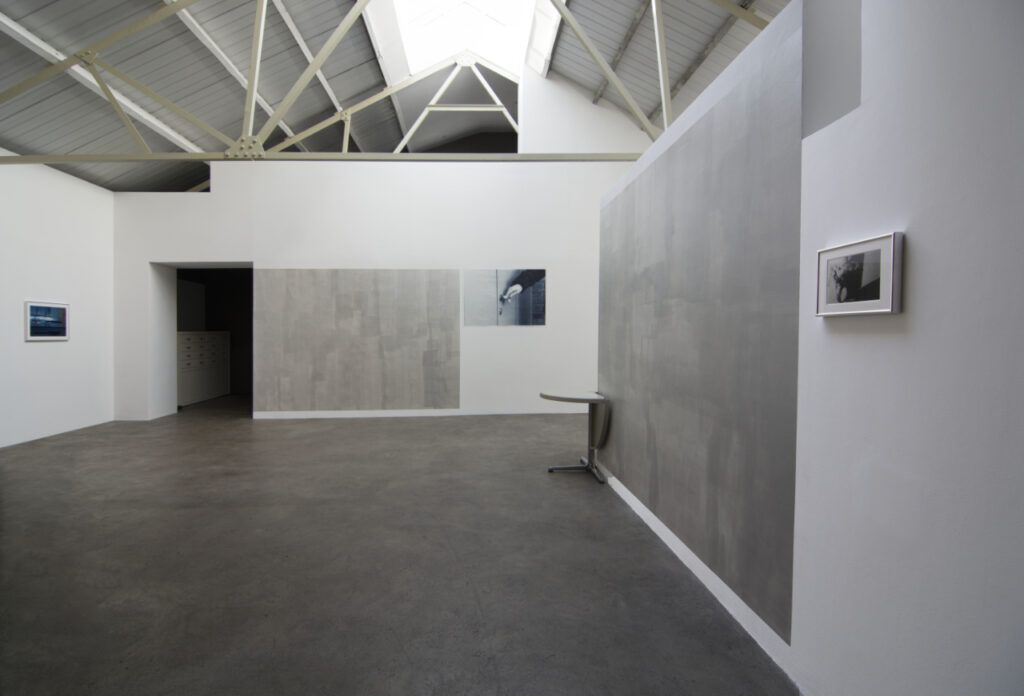
A.Mac Giolla Bhríde explores the haptic and tactile dimensions of modernist architecture through photographic prints, wall paintings, and folding furniture. About Within a mere thirty years after its invention as a gadget for the elite, photography was being used for police filing, war reporting, military reconnaissance, pornography, encyclopedic documentation, family albums, postcards, anthropological records (often accompanied by genocide), sentimental moralising, inquisitive probing, aesthetic effects, news reporting and formal portraiture. With 'socials', influencers, selfies, AI and deep fake, our beautiful, divided, shallow world, is pretty much all of that out the window?… if so, where does that leave the impassioned era of earnest artistic argument/discourse, that, perforce, meant that one strategic chess move connotated the rejection of the previous. Is there anything left to believe in (to reject)? In the same way that Mondrian and Malevich ditched the sentimentalism of Impressionism to eject the mess of human emotion, Greenberg's strict formalism championed "pure opticality", whereas contrarily, his prodigious student Rosalind Krauss actively rebelled against this disembodiment, arguing that art, cannot, be separated from the sensory, the visceral. Touch (the haptic) inherently functions as a (meaningfully) disruptive force against the sterile, hyper-rationalised rules of purely 'visual' modernism. A.Mac Giolla Bhríde's new body (pun significantly intended) of work, for mother's tankstation | Dublin, a lover beneath me, reductively dumps all the above into a post-everything antigrav tank that explodes the visual meaning of touch, post-photographic-veritas, ocular hapticality if you will. If architecture is about living, then so might the spaces that facilitate this, reasonably be alive? you would think so. But in strict accordance with early modernist 'principles', Mies van der Rohe and the Bauhaus architecture school placed the haptic pretty low on the snag list. Softness, comfort, need, desire, luxury, bent to form and function. Line, space, volume, surface (not necessarily for touching), prioritised utility, geometry, industrial materials (machismo and male ego), over malleability, a soft touch (femininity) – if we are looking at this in a binary sort-of-way? A.Mac's old-school photographic documentation, printed on tracing paper almost as architectural blueprints, of a tour guide showing off a Mies building in Berlin, breaks the fundamental museological rule: PLEASE DO NOT TOUCH. Instead, a disembodied hand provocatively plays around with what in the vertical plane looks like a faucet, or access panel concealing messy necessities (?), and horizontally revealed, actually, simply, as a door handle: anodyne, simple, linear, no compromise to the actual form of a human hand. Oddly both orientations of the photographic prints look convincingly 'correct', only serving to emphasise the sensuality of the hand gestures, almost erotically, brushing, caressing and ultimately, grasping, the object of desire – the unyielding ironmongery. Once grasped, hence known, true nature revealed. Vertically, the hand reads one way, horizontally, another. A counterpoint to these (compromised) 'documentary' images, are bodily-scaled wall paintings. Rendered in fluid silver paint directly onto the gallery walls, they are perfectly proportioned according to modernist principles, such as Barnett Newman-like relationships of realisation-to-action. These are once-off, human impressions, or what Krauss called "index", the physical trace describing a direct corporeal consequence of touch, like a footprint in mud or a fingerprint on glass. Having masked a prescribed area of activity, including the necessity of lying on the floor to produce the bottom line, the final painterly 'marking' is entirely reflexive of the pressure of hand-to-roller-to-surface. Ultimately, the visual consequence is something akin to what Rudi Fuchs described as Günter Förg's "soft touch" post-modernism abstractions that are neither decorative, aesthetically or optically beautiful, nor conceptually rigorous, but completely dependent on all of-the-above traditions and schools of 'thought'. To complicate the referential mix, A.Mac Giolla Bhríde has incorporated two items of classic c1970s folding furniture by Giancarlo Piretti. Simultaneously static and mobile, fixed and fluid they act as embodied quotations of modern design principle within the 'physical' structure of the installation. A Plana circular table intersects with the turned corner of one of the two wall paintings, while a Platone, folding desk literally turns its back to 'face' a blank wall – if we are looking at this in an anthropomorphic sort-of-way? Similar to A.Mac's imagery of an unrelenting doorhandle becoming a fetishised, eroticised object of desire, the tables are lent symbolic gestures and personalities. The dense-putty-coloured circular table, deferentially drops its 'leaf', while the solid-white-topped desk recalcitrantly splays its polished chrome legs… Read more Toggle Photography Mixed media Painting Installation
Schedule
Starts
-
Thu, Oct 1, 2026 at 12:00 AM
Ends
-
Sat, Nov 28, 2026 at 11:59 PM
Location
41-43 Watling Street, Usher’s Island, Dublin, County Dublin, D08 NP48, Ireland
ML
Presented by
mother’s tankstation london