Checking payment status…
Registration
Registration for this event is managed on an external website.
RSVPAbout event
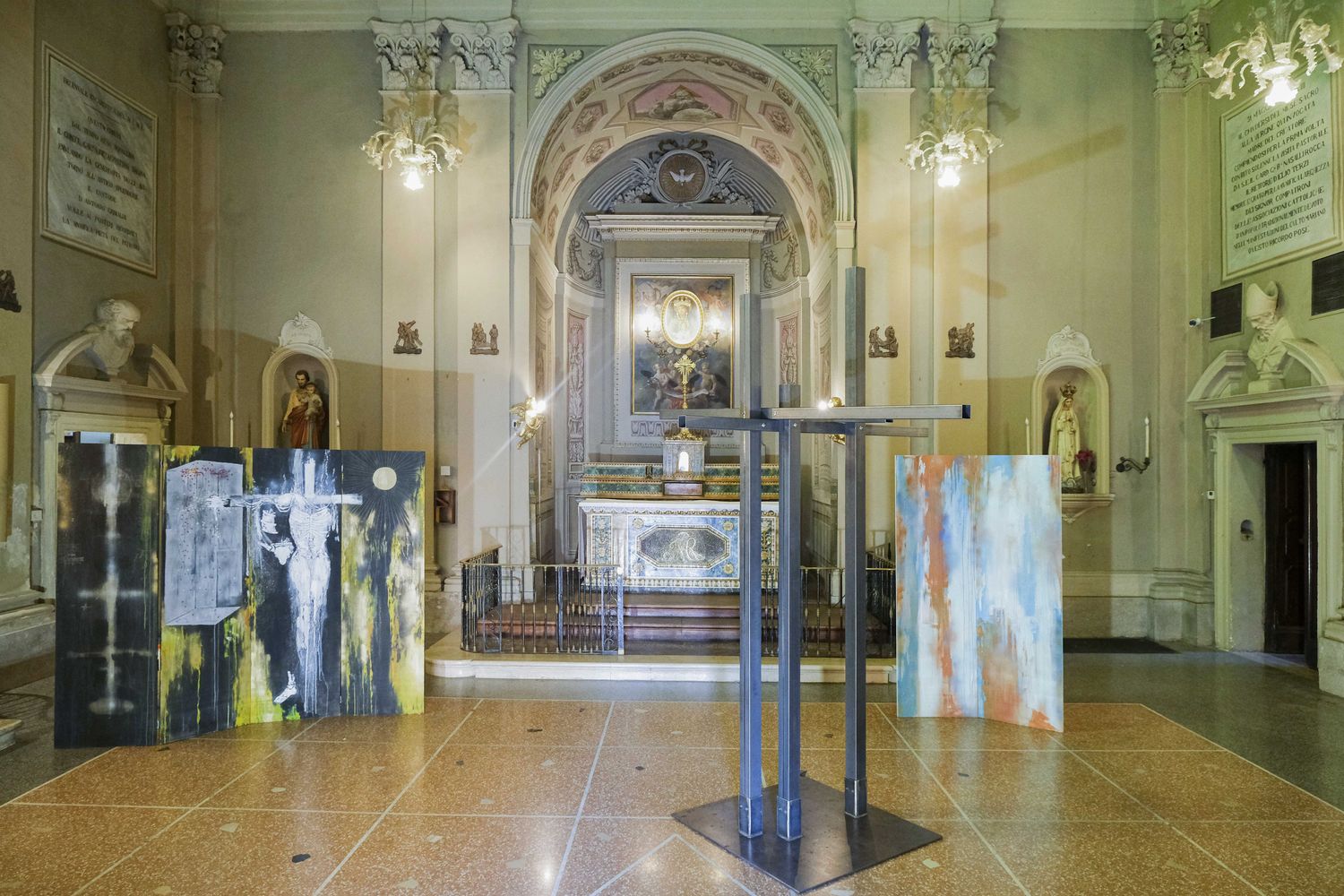
From October 31 to November 15, 2026, the Church of San Valentino della Grada in Bologna will host GOLGOTA, a collective exhibition project by Filippo Cigni, Matteo Gobbo, and Giampaolo Parrilla, curated by Marta Trombini About From October 31 to November 15, 2026, the Church of San Valentino della Grada in Bologna will host GOLGOTA, a collective exhibition project by Filippo Cigni, Matteo Gobbo, and Giampaolo Parrilla, curated by Marta Trombini, which emerged from a collaborative exploration of the theme of the Crucifixion and the relationship between contemporary art and places of worship. Taking as their starting point Annibale Carracci’s *The Crucifixion and Saints*, housed in the nearby Church of Santa Maria della Carità, the artists explore Golgotha as both a physical and symbolic place: not merely the setting for the crucifixion, but a space where death and life, power and renunciation, pain and love intersect. The exhibition engages with one of the foundational images of Western culture to examine the present, which is permeated daily by images of death and suffering. In this context, the Crucifixion becomes an opportunity to rethink our relationship with mortality and to rediscover a sense of balance, awareness, and connection. The works are integrated into the church’s space as new layers of meaning, establishing a dialogue with its architecture, its history, and the community that inhabits it. GOLGOTA thus proposes an encounter between contemporary artistic languages and religious tradition, in the belief that art can still be a tool for storytelling, reflection, and a deeper engagement with life. The artists Filippo Cigni, Matteo Gobbo, and Giampaolo Parrilla embarked on a journey of collective creative work, taking as their starting point the spaces of the two sister churches, Santa Maria della Carità and San Valentino della Grada. They decided to work in harmony, addressing the diversity of their artistic and conceptual approaches and finding a common framework that would allow the work to speak as a collective piece rather than as a collection of disparate individual intentions. The relationship with the works already housed in the churches has become the starting point for a project that has been ongoing for more than two years. This project involves studying the architectural, spiritual, and communal context of Bologna’s churches, with the aim of observing and strengthening the bond between the Church and contemporary art. Recalling a time when art in churches served to interpret prayers and draw people closer to the Divine, this project aims to revive this narrative medium to foster awareness and dialogue about contemporary transitions without forgetting the ethical, religious, and historical foundations that permeate our society. And so, starting from what already exists, layers of meaning are added, bridges are built, and places of faith are honored—places that hold stories within them that can serve as inspiration for our present. Upon entering the Church of Santa Maria della Carità—once the hub of a large community of the faithful but also the setting for various artistic projects—we are captivated by the altarpiece depicting the Crucifixion and Saints by Annibale Carracci. Dating back to 1583, it is identified as Annibale’s first commissioned work—and not the last to draw sharp criticism for the simplicity and directness with which the scene is depicted. It represents an instinctive return to realism and the popular dimension of art, so much so that it depicts a humble altar boy holding the crosier of Saint Petronius, the patron saint of Bologna. Just as Annibale Carracci, through this work, distanced himself from the artistic style of his time, we have decided to break down that boundary between artistic and religious spaces, creating a dialogue open to multiple interpretations. We believe this dialogue is necessary at a historical moment when social narratives are fracturing and there is a need to cling to new stories. Art has always accompanied the Christian faith in the narrative of the readings, guiding believers into stories that came to life and served as visual examples. And art and the Church have always spoken the same language, united in their desire to convey a faith that becomes culture. The contemporary context is a complex, rugged, and distracting landscape that increasingly needs footholds to cling to firmly in order to remain standing, yet it is our time, born of what came before it, and not an entity unto itself. The idea of bringing works by contemporary artists into places steeped in history, such as churches, thus becomes a simple exercise in self-discovery—that anchor that fosters reflection and establishes a profound dialogue between us, art, and faith. The artistic collective has long explored the theme of the crucifixion, drawing inspiration from Annibale Carracci to enter another space rich in narrative: the space of Golgotha. “And Jesus, carrying the cross, set out for the Place of the Skull, called in Hebrew Golgotha, where they crucified him” (John 19:17–30) A rock a few meters high—not a mountain as is commonly thought—located outside the walls of Jerusalem. A place of Calvary, not as a consecration of pain and suffering but as a symbol of love, humility, and self-sacrifice. A place where domination and power are foreign, and where, through renunciation, life and death become a circle and no longer merely a beginning and an end. There’s nothing we need less today than to talk about death. And yet, death in the modern world is ever-present—in our daily lives, in the news from around the world, and in our thoughts. Death as an end, as a destination—death that frightens us. And yet, if we pause for a moment, simply thinking and breathing, we realize just how closely death is connected to life. How necessary that space of spiritual balance becomes between the beginning and what we think is the end. “The free man thinks of nothing but death, and his wisdom is a meditation not on death but on life.” (Spinoza) Spinoza reminds us to relate to the fear of our own death without letting it guide us, but rather as a consequence of our actions and not as a given. In fact, the free man lives “according to the principle of the pursuit of his own good,” and consequently—only as a result—does he not fear death. To return to life and faith through an awareness of our relationship with death, so that we do not forget to continue creating narratives and relationships. Marta Trombini Read more Toggle Painting Mixed media
Schedule
Starts
-
Sat, Oct 31, 2026 at 12:00 AM
Ends
-
Sun, Nov 15, 2026 at 11:59 PM
Location
Via Monaldo Calari 10, Bologna, Emilia-Romagna, 40122, Italy