Exhibition
Ibrahim Said: Shaping Time
Thursday, October 22
12:00 AM - Jan 9, 11:59 PM
Yossi Milo Gallery
New York, United States
Checking payment status…
Registration
Registration for this event is managed on an external website.
RSVPAbout event
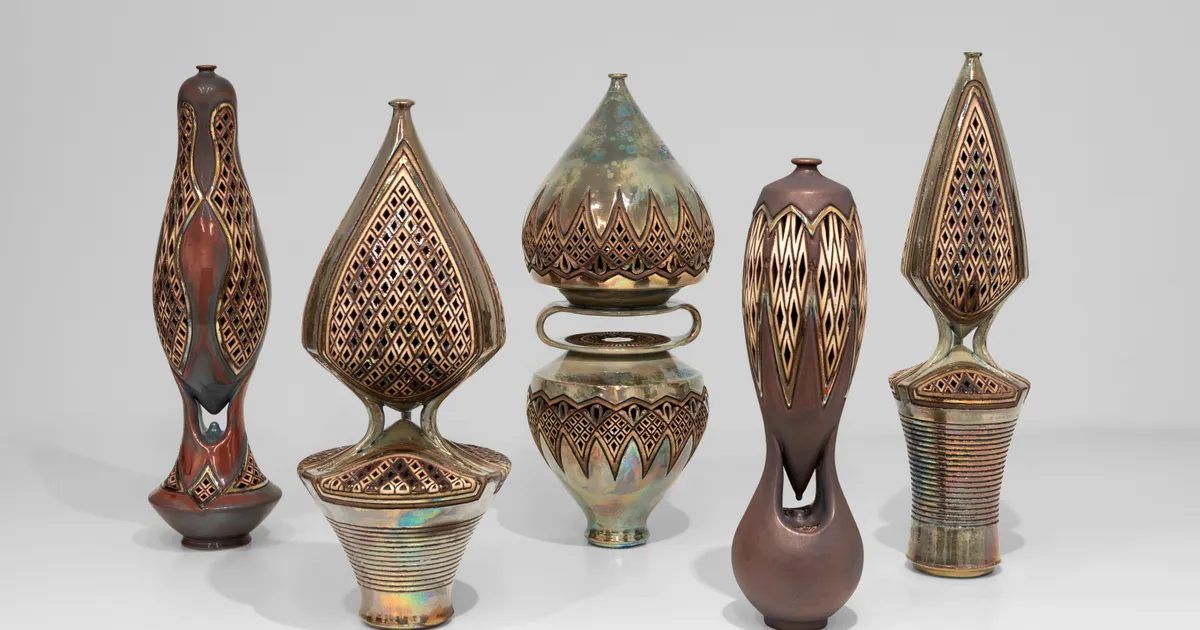
Shaping Time is Ibrahim Said's second solo presentation with Yossi Milo, coinciding with the conclusion of his participation in The Metropolitan Museum of Art and Vacheron Constantin Artisan Residency. About Yossi Milo is pleased to announce Shaping Time, Ibrahim Said's second solo presentation with the gallery. The exhibition will open with an artist's reception on Thursday, October 22, from 6-8 PM, and will be on view from Thursday, October 22, through Saturday, January 9, 2027. Shaping Time coincides with the conclusion of Said's participation as one of the three inaugural artists in The Metropolitan Museum of Art and Vacheron Constantin Artisan Residency. Centered on the preservation and reinterpretation of traditional craft, this 18-month residency granted Said sustained access to The Met's collection. This period of research and close engagement with the museum's holdings informed much of the development of this new body of work. Across sculpture, ceramic forms, and intricately constructed surfaces, Ibrahim Said (b. 1976; Cairo, Egypt) considers time not as a fixed progression from past to future, but as a layered condition in which histories and imagined futures continually overlap. In Shaping Time, Said draws from different conceptions of temporality, moving between linear time, and the more expansive structures of sacred, spiritual, and cosmic time. References to ancient Egyptian and Islamic art appear throughout the exhibition, connecting systems of image-making developed across centuries with forms that can appear distinctly contemporary, and, at times, futuristic. Representations of time and the afterlife provide one framework through which the works are realized. In ancient Egyptian art, scale could communicate hierarchy and significance, while images and symbols connected earthly existence to a much larger conception of life beyond death. Said reconsiders these ideals through shifts in scale and the organization of forms, using composition to suggest relationships that are spatial as well as symbolic. Islamic geometry offers another foundation for Said's approach to repetition, continuity, and infinity. Geometric structures, mirrored forms, latticework, hexagons, the six-pointed form of the Star of David, and the Coptic cross embedded with eight-and-four-pointed star forms appear as references through which images are joined, folded, and multiplied. Moving between religious and visual traditions, these structures allow Said to consider how symbols persist while acquiring new meaning. Their repetition suggests forms extending beyond the physical boundaries of the objects themselves, connecting the finite experience of the individual to ideas of continuity and belief. Rather than collapsing their distinctions, Said looks toward what he understands as a common humanity within religious experience. This engagement with history is inseparable from Said's process of making. His work moves beyond conventional ideas of beauty towards an investment in skill, precision, and the pursuit of perfection within these forms. Sculptural plates and elaborately constructed surfaces foreground the labor involved in their production, while pattern, scale, and structure become records of duration in themselves, evidence of time embedded through the process of making. Across Shaping Time ancient forms are neither treated as relics, nor positioned in opposition to the future. Instead, Said brings different periods and visual languages into the same object, proposing a continuum in which histories remain active, and multiple systems of belief and experiences can coexist. His works look backward and forward simultaneously, treating time as material, and suggesting that shaping an object is also a way of shaping our relationship to time. Works by Ibrahim Said are held in the permanent collections of major public institutions including the Bait al-Baranda Museum, Muscat, Oman; Colby Museum of Art, Waterville, ME; Des Moines Art Center, Des Moines, IA; Kalamazoo Institute of Art, Kalamazoo, MI; The Mint Museum, Charlotte, NC; Museum für Kunst und Gewerbe, Hamburg, Germany; Museum of Modern Egyptian Art, Cairo, Egypt; National Museum of Scotland, Edinburgh, Scotland; Philadelphia Museum of Art, Philadelphia, PA; and the Victoria and Albert Museum, London, England. In 2024, Said's work Hourglass was acquired by the Brooklyn Museum, Brooklyn, NY. In 2025, Reflection was acquired by the Renwick Gallery of the Smithsonian American Art Museum, Washington, D.C., and Karnak 1 was acquired by the North Carolina Museum of Art, Raleigh, NC. The artist received the 2024 Maxwell/Hanrahan Award in Craft and, in 2025, was selected as one of three artisans for a new 18-month residency program at The Metropolitan Museum of Art in collaboration with Vacheron Constantin. Said has mounted solo and group exhibitions at the Cary Arts Center, Cary, NC; Claymakers Gallery, Durham, NC; New Bedford Art Museum, New Bedford, MA; Saudi Arabia Museum of Contemporary Art, Riyadh, Saudi Arabia; Bardo National Museum, Tunis, Tunisia; Museum of Arts and Design, New York, NY; and the American Academy of Arts and Letters. Read more Toggle Sculpture Crafts
Schedule
Starts
-
Thu, Oct 22, 2026 at 12:00 AM
Ends
-
Sat, Jan 9, 2027 at 11:59 PM
Location
245 Tenth Avenue, New York, New York, NY NY 10001, United States