Exhibition
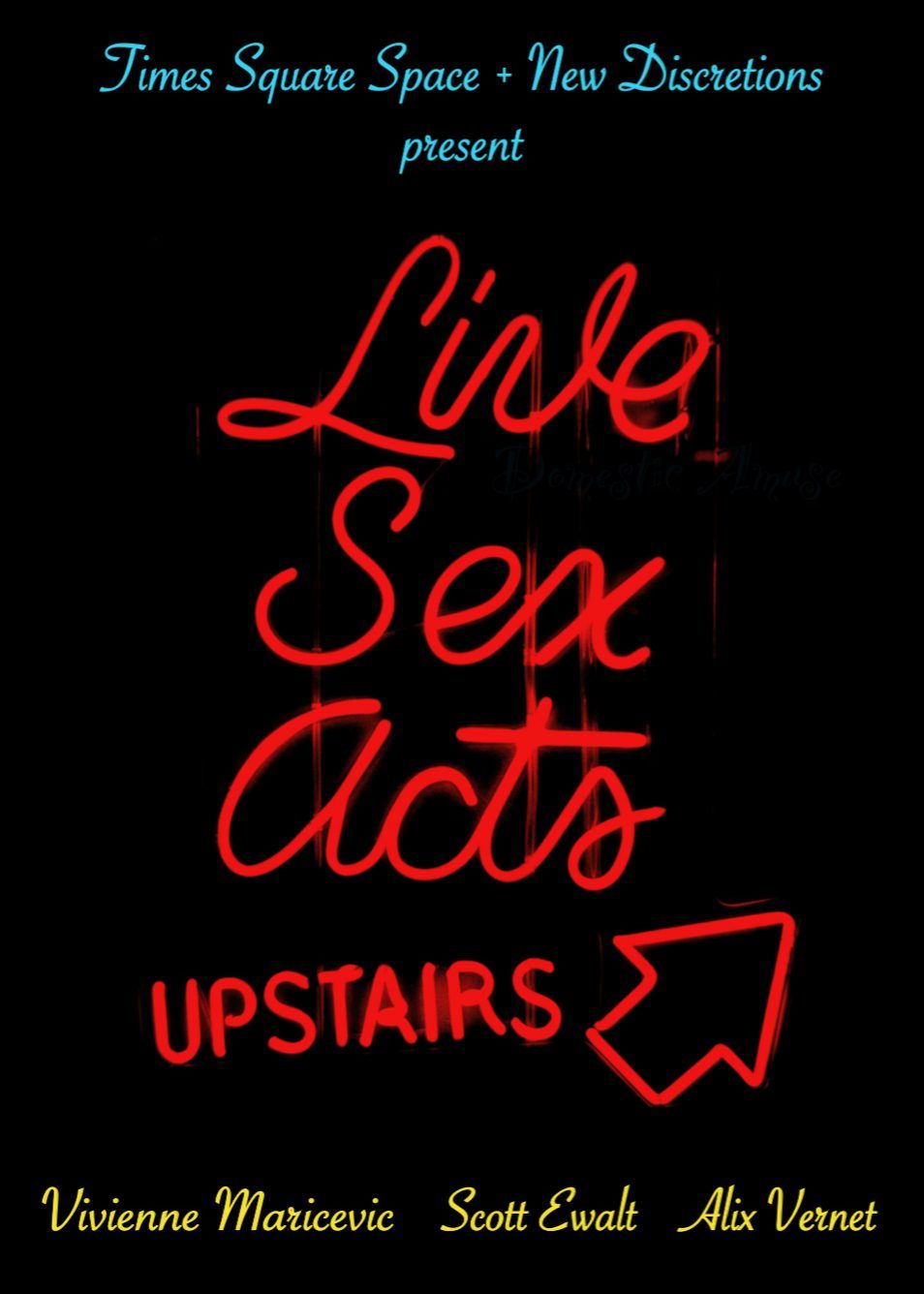
Live Sex Acts
Friday, September 18
12:00 AM - Nov 15, 11:59 PM
Times Square Arts
New York, United States
Checking payment status…
Registration
Registration for this event is managed on an external website.
RSVPAbout event
An exhibition bringing together Vivienne Maricevic, Scott Ewalt, and Alix Vernet, curated by Benjamin Tischer and Tiffany Zabludowicz, forming an archive of Times Square's vibrant sex clubs from the late 1960s through mid-1980s. About Times Square Space and New Discretions present Live Sex Acts, an exhibition bringing together Vivienne Maricevic, Scott Ewalt, and Alix Vernet, curated by Benjamin Tischer and Tiffany Zabludowicz, on view from September 18 through November 15, 2026. Three artists form an archive of Times Square's vibrant sex clubs, which were active from the late 1960s through the mid-1980s. There existed a dense, largely self-regulating ecosystem of sex clubs, porn theaters, peep shows, and strip clubs that operated in the space the city had abandoned. None of the works moralize or mythologize; rather, they are records made by artists who understood the value of what they were looking at before it was gone or who have returned to its traces. This exhibition opens at a moment when the political gains of the last several decades are being actively reversed, when bodies, desires, and the spaces that accommodate them are once again subject to legislation and erasure. In that context, an archive of Times Square's sex culture is not a historical exercise but a reminder that these freedoms were always contingent, always contested, and always worth defending. Vivienne Maricevic moved through spaces that most photographers never entered, gaining access to the secret backrooms of clubs through relationships built on genuine trust and mutual respect. After recognizing a lack of male nudes in art, she began photographing them regularly. Soon after, she discovered a male burlesque club in Times Square which led her to the live sex clubs. More than sixty-five of her photographs are featured in this exhibition, highlighting Times Square's most decadent decade, the 1980s, and clubs including Show World, the Pussycat, 7-11, the Avon, Bryant Theatre, the Ramrod, Big Top Lounge, Show Palace Follies, the Unicorn, Crazy Horse, Hombre, and Chez Elle. Maricevic's photographs are a testament to that era. Every person she photographed gave their consent. Her photographs are portraits are made from the inside by someone who understood what she was looking at and why it mattered, which is evidenced by their warmth and joy. In her words, "the energy, the life and the character are all gone, but Times Square will always have a special place in my heart." When Times Square was being dismantled starting in the late 1980s, Scott Ewalt mounted a systematic effort to save what he could, befriending the women who ran the theaters that he frequented, negotiating with demolition crews, and acquiring the signage, posters, and memorabilia that would otherwise have been destroyed. His work was inspired by the disappearing landscape and is an attempt to recreate the spirit of the red-light district. In this latest work Ewalt depicts the world of 1950s punk artist Gene Bilbrew with his collaborators and muses in front of the three businesses that they filled with hundreds of unique publications, live shows and films. This subculture of rebels against the sexual repression of the cold war was an alternative reality that inspired generations of outsiders without widely being acknowledged. Alix Vernet's system of archiving is more fragmented, highlighting the challenge of looking back at a history that is almost entirely hidden. Discovering a peep show in Philadelphia owned by the same person behind Show World, she tracked down the remains of its neoclassical awning and cast the remaining objects. A slide projector that looks simultaneously like a peep show and a surveillance camera, Viewers depicts an original negative slide of the building before it was demolished. Vernet simultaneously recreated the neon lights of the peep show window, titled 60/40 in reference to New York City's "60/40" rule, part of the city's adult-use zoning framework. Under the rule, businesses with 40 percent or more of their stock or customer-accessible floor area devoted to adult material could be classified as adult establishments and become subject to location restrictions. These regulations contributed to the disappearance of Times Square's sex clubs. These three elements create an overarching image of the club through traces, highlighting how challenging it is to track down a subculture that has been dismantled. What grew in the sex clubs was a form of social life: anonymous, cross-class, and largely ungoverned. Crucially, it was where queer life organized itself outside the surveillance of mainstream culture and where art, activism, and sexuality overlapped. The darkened theaters and club backrooms offered freedom from judgment and taboo and, in doing so, created the conditions for a potent subculture. That culture had consequences that are still alive. Artists moved directly from Times Square's live sex performances to the downtown performance art scene, carrying with them the logic of the sex club, its refusal of shame, and its insistence on the body as a site of both pleasure and politics. The sex-positive club nights, queer performance, and community organizing that characterize New York's underground today are in direct conversation with what Times Square once made possible, even as the geography has shifted entirely. Vivienne Maricevic and Scott Ewalt will also be in conversation at the Printed Matter Book Fair at MOMA P.S.1 at 3 PM on Saturday, September 26th, celebrating the publication of New York Then by Cultural Traffic, as well as remembering the heyday of Times Square. Read more Toggle Mixed media Photography Installation
Schedule
Starts
-
Fri, Sep 18, 2026 at 12:00 AM
Ends
-
Sun, Nov 15, 2026 at 11:59 PM
Location
1560 Broadway, Suite 800, New York, New York, 10036, United States