Checking payment status…
Registration
Registration for this event is managed on an external website.
RSVPAbout event
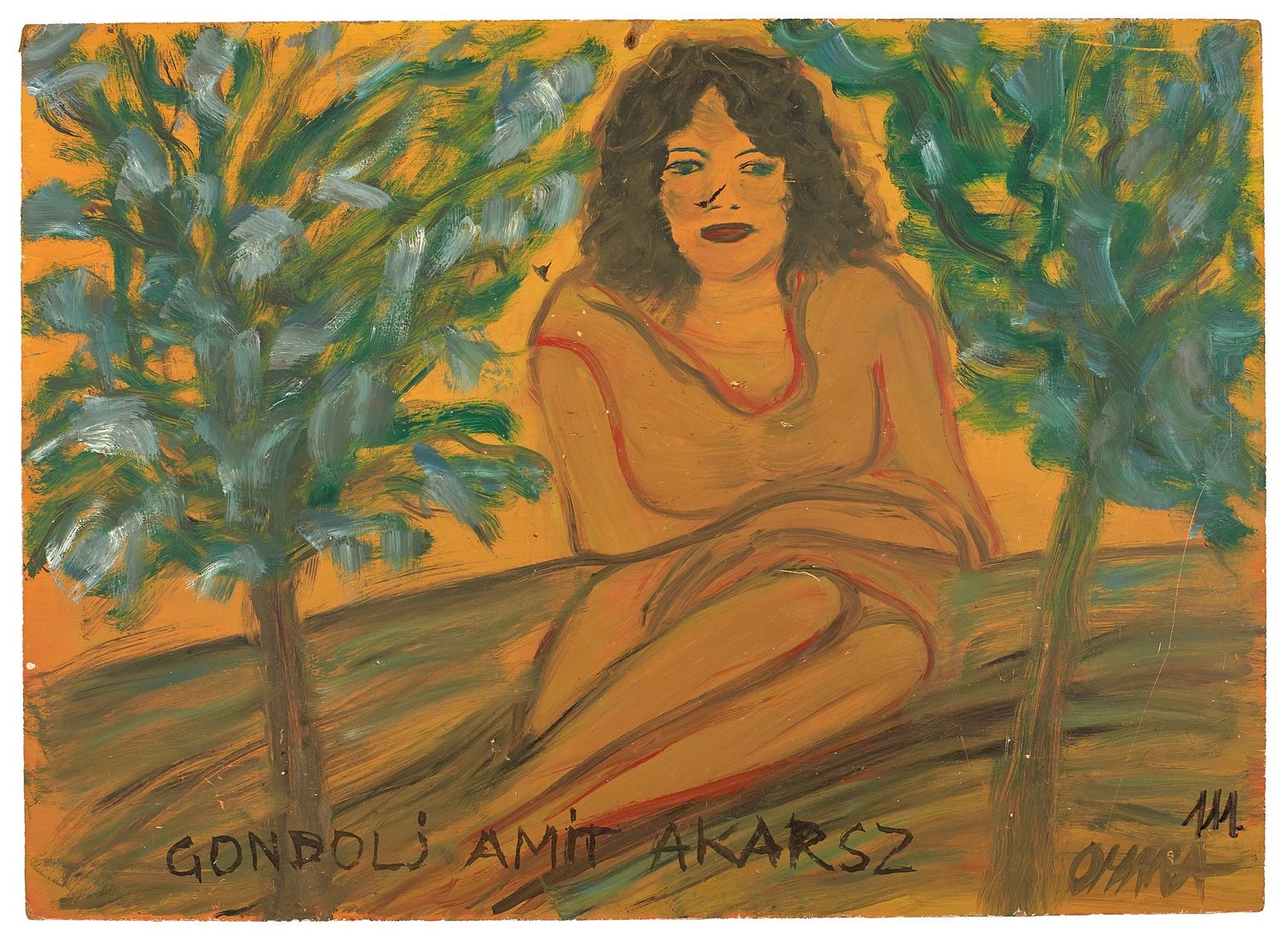
OMARA (Mara Oláh), a self-taught Hungarian Roma artist (1945–2020), worked across painting, drawing, photography and performance, blending autobiography with social critique. About OMARA (Mara Oláh) (b. 1945, Monor, Hungary; d. 2020, Szarvasgede, Hungary) was a Hungarian Roma artist who worked across painting, drawing, photography and performance, and is considered one of the most significant contemporary Roma artists. The exhibition's Hungarian title is taken from the artist's quote in Ábel Sánta's short documentary Omara (2024), in which the artist acknowledges her sometimes difficult nature before challenging others to follow her example: do it after me, if you can. She also wrote the sentence across some of her miniature paintings ("Csináld utánam, de neked is egy szemed legyen és cigány legyél." / Do it after me, but you should also have just one eye, and be a gypsy!). Both a dare and a gesture of encouragement, the phrase captures something of her relationship with her own community. While fiercely outspoken against the racism and discrimination faced by Roma people, OMARA was equally known for urging members of her community to take their futures into their own hands rather than wait for change to come from elsewhere. She took immense pride in what she had achieved through her own determination, and painting played an essential part in that process. Her works recorded her ambitions and accomplishments, turning personal milestones into public declarations and, at times, helping to bring those ambitions into being. Throughout her life, OMARA was determined in naming what she wanted and pursuing it on her own terms. OMARA was entirely self-taught, and the origins of her artistic practice sprung from the necessities of everyday life. In 1988, at the age of forty-three and not long after the sudden death of her mother, she was suffering from an intense migraine. She asked her daughter for paper and a pencil and drew the actress Sophia Loren, who would remain a recurring figure in her imagination, and by the time the portrait was finished, the pain had eased. Sophi Loren (1988) sets out the terms on which she would make art from then on: autobiographical, therapeutic and transformative, a way of processing illness, recovery and the problems of everyday life, and of willing new possibilities into being. She went on to develop a radically direct visual language that mixed figuration with handwritten text, autobiography with social critique, humour with rage, and tenderness with a confrontational refusal of passivity. As she said, "I paint the story of my life, which consists of a series of conflicts". By the late 1990s, OMARA began writing directly onto her paintings and photographs, making her own voice inseparable from the images and their interpretation. Her inscriptions move freely between personal recollections, dreams, encounters and jokes, as well as direct demands and accusations addressed to viewers and those responsible for injustices against her and the wider Roma community. At times, they serve more practical purposes, functioning as credits or tools of self-promotion, even including her website address. Whether intimate, confrontational or matter-of-fact, these texts insist on her authority to tell her own stories and determine how her work is seen and understood. They borrow from television, protest placards, tabloid headlines and everyday speech, and turn painting into a form of direct communication. The tone is humorous, direct and fearless: often ironic, at times confrontational, and grounded in a refusal to separate lived realities from the work. The same appetite for self-presentation took her beyond the studio. In 1993 she opened Mara Gallery in her apartment, the first private Roma gallery in Hungary, and over the years she appeared on television as a fortune teller, staging herself as diva, artist, mother, provocateur, activist and survivor. No figure recurs in the work more often than her daughter. OMARA painted her almost a hundred times, as confidante, muse and companion and, in the artist's own words, her "only diamond". My Diamond (Az én gyémántom) (1996), exhibited here, belongs to this long series of portraits. Several of the paintings carry inscriptions declaring that they belong to her daughter, and in these private feeling is stated as public fact, in a practice that refuses any separation between private experience and public struggle. Her daughter was also the inspiration behind OMARA's iconic blue paintings. In 1997, OMARA recalled having a dream in which she was instructed to paint a name-day gift for her daughter in blue. As she recounts in her autobiography, blue had always been her daughter's favourite colour: the colour of her best childhood dress, the colour she wanted for her room, and even the colour that mysteriously appeared in photographs they took together. What began as a gift grew into an extensive series of paintings in luminous shades of blue and white, intimate and confessional in tone, reflecting on her relationship with her daughter, the difficulties of motherhood, illness, poverty, racism and her experiences as a Roma woman. Among the most personal and recognisable bodies of work in her oeuvre, paintings from the series have been exhibited in The Hidden Holocaust at Műcsarnok/Kunsthalle Budapest (2004), Lost Paradise at the Venice Biennale's first Roma Pavilion (2007), Time Machine at the Ludwig Museum, Budapest (2020–2025), and, most recently, This Is What I See From the Back Window at Sunset at the East Slovak Gallery, Košice (2026). The exhibited Twins (1997–2003), a mirrored double portrait of two women, belongs to this series. By 2007, these confessions had found an international audience, when OMARA took part in the First Roma Pavilion at the 52nd Venice Biennale (2007), curated by Tímea Junghaus. But home remained the place where everything came together. In Szarvasgede she built herself a house with her own means and called it her "luxury shack". She covered its exterior with painted scenes and text, turned her living space into an exhibition site, and made performative and activist gestures that challenged institutional structures and asserted her presence within them. Inside, paintings of family memories, dreams, racial violence, political demands and personal achievements hung side by side, a dense and constantly expanding visual history. Her miniature paintings (2008–2010) offer the most immediate record of that life. Painted on roughly cut pieces of fibreboard that she cut to size herself, they depict the lush natural landscape surrounding her "luxury shack", alongside portraits of people in her community. Quick, spontaneous and diaristic, they record her surroundings and everyday experiences. Their modest scale allowed her to work freely and prolifically, building up a substantial body of paintings through daily practice. The format also suited her circumstances, making economical use of limited space and the materials available to her. Alongside these more intimate records of everyday life, the exhibition presents another central aspect of OMARA's practice: her political paintings, which address and confront racism, police harassment, economic precarity, housing inequality and institutional discrimination. This is how thieves collect tax in Szarvasgede! (2016) relates to her move to the village, where several houses stood empty following the deaths of their former inhabitants. Rather than take one over, OMARA ordered the materials and built her own. Getting to know the local postman, she learned that municipal waste-tax bills were still being delivered to owners who had died, and, outraged, she turned the episode into a cemetery scene in which the postman moves among the graves as though collecting the tax from the dead themselves. Rooted in her experience as a Roma woman and in personal observation rather than fixed political categories, the painting turns a specific and seemingly minor incident into a wider critique of bureaucratic indifference, and of the way economic pressure falls on communities that are already marginalised. The emphatic title turns her indignation into an accusation, while the absurdity of the scene gives the work its dark humour. It was included in DIKH OMARA at gta exhibitions, ETH Zürich (2024), the first monographic survey of her work in Switzerland. "Do it after me." brings together the many facets of an extraordinary life and practice: the diva and provocateur, the loving mother, the fortune-teller, the outspoken activist, the proud Roma woman, the public figure and the fearless artist. Together, they reveal an artist for whom painting was inseparable from the experience of living, a means of asserting her voice, claiming her place in the world and confronting the injustices she faced. As OMARA reflects in Sánta's film: "Had I not experienced so much humiliation, shaming, contempt and hatred, there would be none of the otherness in my paintings that makes them unique. With every work, I want to express emotions, tell stories, and wage a struggle for freedom against injustice." OMARA exhibited widely in Hungary and internationally. Early solo presentations include exhibitions at Naïv Művészeti Múzeum, Kecskemét (1992); American Embassy, Budapest (1993), and the Hungarian Cultural Institute, Paris (2000); Kultiplex Cultural Centre, Budapest (2000). Her work entered a broader institutional context through group exhibitions including The Hidden Holocaust, Kunsthalle Budapest (2004); Basic Instinct – Contemporary Roma Art in Hungary, Hungarian Institute, Berlin (2004); Common Space – Issues of Ethnical Minority and Cultural Identity in the Carpathian Basin, Ernst Múzeum, Budapest (2006); Lost Paradise (Roma Pavilion), Venice Biennale, Venice (2007); Gender Check: Femininity and Masculinity in the Art of Eastern Europe, MUMOK (2009). Selected solo exhibitions include The Jewelry of One-Eyed Omara is Only Visible With a Magnifying Glass, Liget Galéria, Budapest (2011); Think What You Want, aqb Project Space, Budapest (2017); OMARA – Mara Oláh, Pina, Vienna (2022); An eclectic attempt to complete the torso in my head + Omara (Mara Oláh), UGM Studio, Maribor (2022); Omara (Mara Oláh), Longtermhandstand, Budapest (2023); DIKH OMARA, gta exhibitions, ETH Zürich / ONA Fokushalle, Zurich (2024); Guess what, I'm still here, Margot Samel (2025). Selected group exhibitions include Handle with Care, Ludwig Museum – Museum of Contemporary Art, Budapest (2023); Not Either Or, But And, Das Weisse Haus, Vienna (2023); Darker, Lighter, Puffy, Flat, Kunsthalle Wien, Vienna (2024); The Museum Between the Square and the Palace: Warsaw Under Construction 16, Museum of Modern Art, Warsaw (2025); Passing the Fugitive On, 13th Berlin Biennale, KW Institute for Contemporary Art, Berlin (2025). Crucially, her work was also included in One Day We Shall Celebrate Again: RomaMoMA, documenta fifteen, Fridericianum, Kassel (2022), where her paintings and a film by János Sugár were presented within the RomaMoMA curatorial framework. Her works are included in major public collections including Ludwig Museum, Budapest; Victoria and Albert Museum, London and the Museum of Ethnography, Budapest among others. "Do it after me." ("Csinálják utánam.") is the first UK solo show of work by OMARA, organised in collaboration with Longtermhandstand, Budapest. Read more Toggle Photography Painting Drawing Performance / Live Art
Schedule
Starts
-
Fri, Nov 13, 2026 at 12:00 AM
Ends
-
Sat, Dec 19, 2026 at 11:59 PM
Location
270-276 Kingsland Road, (Entrance on Acton Mews to rear of the building), London, E8 4DG, United Kingdom