Exhibition
Spectral Kinship
Wednesday, September 23
12:00 AM - Nov 7, 11:59 PM
A.I. Gallery
London, United Kingdom
Checking payment status…
Registration
Registration for this event is managed on an external website.
RSVPAbout event
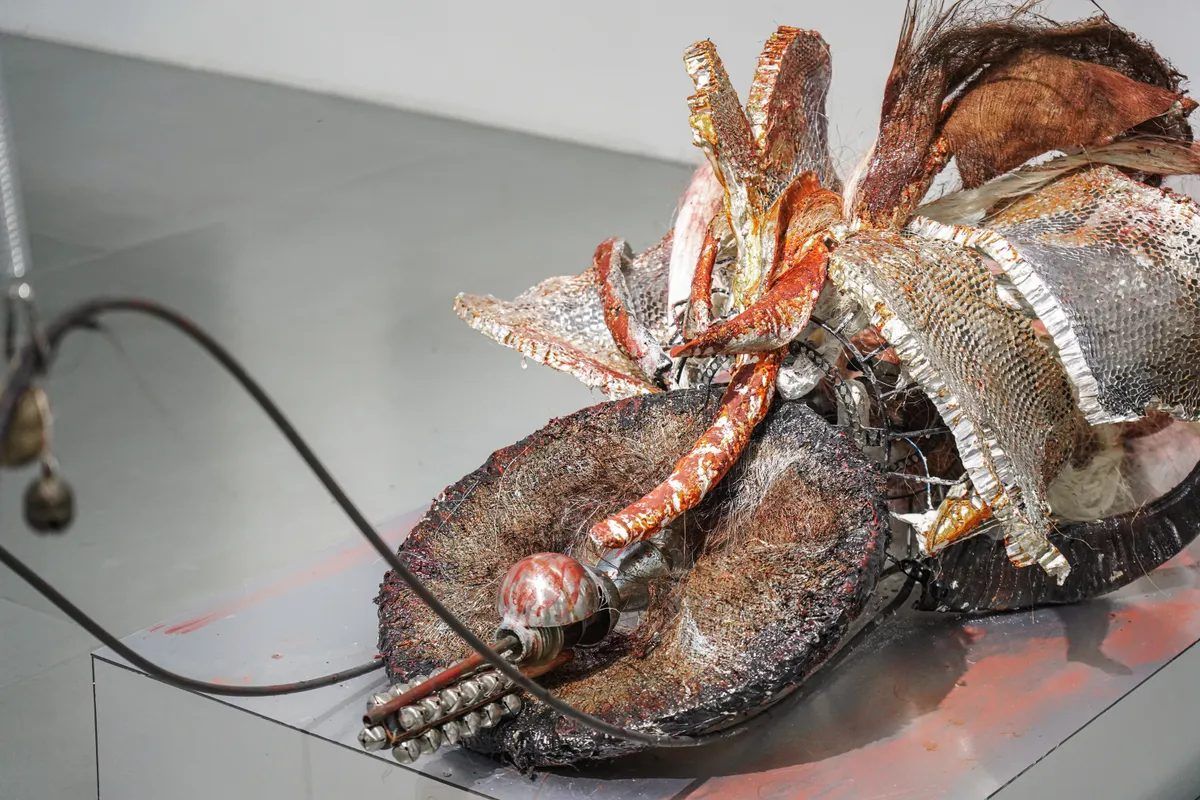
A group exhibition curated by Sophie Guo bringing together six artists whose works explore silenced subjects through sound, ritual, materiality and form. About Spectral Kinship is a group exhibition curated by Sophie Guo. It brings together six artists whose works give voice to silenced subjects and explore how suppressed histories and unaccommodated desires are made palpable through sound, ritual, materiality and form. Featured artists are: Kent Chan (b. 1984, Singapore; living in Amsterdam), Charmaine Poh (b. 1990, Singapore; living in Berlin), Alison Wing Yin Poon (b. 1996, UK; living in London), Caroline Wong (b. 1986, Malaysia; living in London), Liu Xuan (b. 1991, China; living between Jiangxi & London) and Mingxuan Zhang (b. 1998, China; living in London). This exhibition is the third show in the gallery's ongoing theme of sound. Spectral Kinship brings together six artists whose works give voice to silenced subjects and explore how suppressed histories and unaccommodated desires are made palpable through sound, ritual, materiality and form. Drawing on Avery Gordon's account of haunting as a social force that makes the present waver, the exhibition approaches the spectral as a condition of latency: elusive or buried beneath the surface, yet continually seeping across seemingly impermeable temporal and spatial boundaries and reverberating through everyday life. Spanning film, sound, painting, sculpture and kinetic installation, the exhibition attunes to spectral traces and resonances that connect otherwise disparate histories and embodied experience into relation across postcolonial, trans-Asian and trans-tropical sites. It amplifies the sounds through which subjects and collectivities negotiate systems of domination and compose new acoustics of solidarity and resistance. Elsewhere, bodily friction and intimacy, material witness and translation, animist and animalistic forms register experiences that lapse from any predetermined knowledge or taxonomy. Moving between ancestral villages and portal cities, the works forge alternative kinships among migrant women, ancestors, mythological figures, bodies and ecologies, proposing forms of healing that accommodate desires foreclosed by bloodline and the nation-state. On the ground floor, a painted folding screen by Caroline Wong (b. 1986, Malaysia; living in London) depicts a group of the artist's friends in her studio, getting ready to pose for her Picnics and Parties series. Originally made for her models to change behind and to conceal parts of the workspace, the life-size screen functions as both an artwork and an extension of the studio. Wong adapts Fumie Taniguchi's Preparing to Go Out (1935), which in turn draws upon the Edo-period Matsuura screens, featured on the screen. This art-historical lineage channels Taniguchi's portrayal of confident young women, emblematic of women's growing social and financial independence in 1930s Japan, with Wong's exuberant celebration of female friendship and the shared pleasures of dressing each other and getting ready for a party. Alison Poon (b. 1996, UK; living in London), who appears on Wong's screen, dismantles and reweaves found rattan and bamboo furniture that reached British interiors along routes shared with Chinese porcelain. Ceramic inserts painted to imitate lacquer keep questions of authenticity and value open. In Pot Luck, a red female torso patterned after cloth found in a Peckham charity shop rests on a rattan stool, interrogating the making of the Asiatic feminine through and as ornament. A Coiled Connection, shaped as a dressing-table mirror, reflects Poon's journey to her family's ancestral town in Guangdong, a pilgrimage of sorts that prompts her to reassess her mixed English and Malaysian-Chinese heritage from the unstable position of neither tourist nor resident. Adorned at the Final Meeting collates disparate memories of her Chinese grandmother. Its red motif derives from the grandmother's wedding dress, worn in photographs kept on mantelpieces in Malaysia and England. Hanging elements echo the earrings she gave Poon at their last meeting before her sudden passing, while the rattan bindings mimic the chair in which she spent her final moments. The body takes on a more unruly form in the paintings of Mingxuan Zhang (b. 1998, China; living in London). Drawing on the raw physicality of butoh, Zhang depicts spectral figures whose gestures are intimate and contorted, at times delirious. Her figures are conjured through a labour-intensive process that sits between painting and printmaking. She stretches heavy nylon tights until they tear, secures the torn fabric over cut boards, inks the boards black and presses them to the canvas. By repeating the bodily actions of stretching, tearing and imprinting, each painting records the physical intensity from which it emerged. Although hosiery carries associations with desire and the sexualised female body, Zhang unsettles this familiar trope by minimising or erasing her figures' faces and distorting their flesh into viscous, unfamiliar forms. Anonymous bodies bend, dance and gather in a ritual-like scene poised between intimacy and violence, their heads merging with the dark sky as they appear to celebrate the unbuttoning of a pale central figure against a warm, volcanic ground that tempers danger with flashes of humour and sensuous beauty. Ritual takes on sonic and kinetic form in the sculptures of Liu Xuan (b. 1991, China; living between Jiangxi and London). Named after the heroine of Dvořák's opera, the Voice of Rusalka recalls the water nymph who relinquishes her voice to attain human form and love. For Liu, it offers a means of facing childhood trauma and restoring voice to both Rusalka and the artist herself. Liu assembles horn, wood and oil palm from her home province of Jiangxi with glutinous rice paste, cashew lacquer and scrap metal salvaged from Fengcheng's recycling industry, forming a wounded, siren-like body of animal, vegetable and industrial matter. Weaving and lacquering further embed the work in embodied technologies of making historically rooted in the agrarian rituals of her hometown. The pull of a cord animates the sculpture and sets the bronze bells ringing, returning Rusalka's lost voice as a ritualistic soundscape that reverberates through the gallery. Liu's new kinetic sculptures carry the healing power of sound into more relational forms: two oscillate between attraction and repulsion, drawn together and prised apart in turn, so that intimacy is never free of struggle, nor shedding a former self without friction. Pressed on vinyl, Kent Chan's sonic work (b. 1984, Singapore; living in the Netherlands) plays the tracks that punctuate the speculative filmic world of Solar Orders, which imagines a future in which the tropics continue to expand under climate change and the sun becomes society's organising principle. Solar deities, mythologies and principles converge in a prophetic register. Chan's formulation of a 'solar and sonic alliance' proposes music as a means of attuning the terrestrial to the solar while challenging lingering colonial faultlines. The work's multiple voices form a polyphonic kinship across climates, geographies and histories of tropical regions we know today. On the lower ground floor, The Moon is Wet, a three-channel film by Charmaine Poh (b. 1990, Singapore; living in Berlin) centres on three migratory figures across Singapore's history: the sea goddess Mazu; a majie, also known as a 'self-comb woman' who migrated to British Malaya for domestic work; and Monic, an Indonesian domestic worker. Speaking in Hokkien, Cantonese and Indonesian respectively, they inhabit fluid timelines, paralleling and at times addressing one another. Their spectral kinship forms an alternative to the forefather's historicity through which Singapore's national history has often been narrated. While majie are remembered predominantly as industrious labourers who contributed to the nation-building years, their intimate desires and the forms of kinship they created remain difficult to locate in the archive. Set along Singapore's intertidal zone, the film relates these migrant histories to the ecological lives buried through land reclamation. Through voice, song and speculative ancestry, Poh allows histories displaced by state-driven progress to resurface without being resolved into a single lineage. Read more Toggle Installation Film / Video Sculpture Painting
Schedule
Starts
-
Wed, Sep 23, 2026 at 12:00 AM
Ends
-
Sat, Nov 7, 2026 at 11:59 PM
Location
1a Tenter Ground, London, England, E1 7NH, United Kingdom