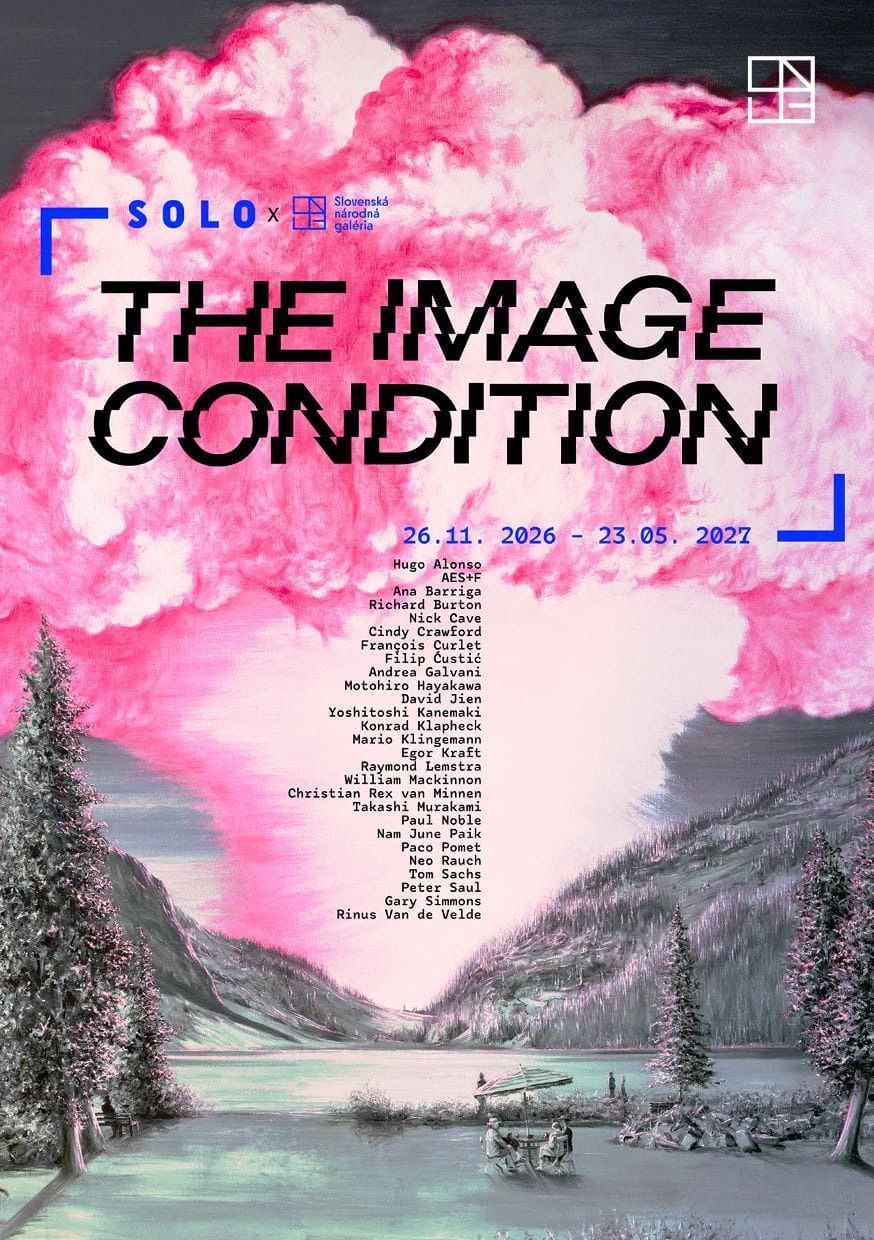
Exhibition
The Image Condition
Thursday, November 26
12:00 AM - May 23, 11:59 PM
Slovak national gallery
Bratislava, Slovakia
Checking payment status…
Registration
Registration for this event is managed on an external website.
RSVPAbout the event
An exhibition featuring works from Collection SOLO explores how images shape identity, organize collective experience and transform our understanding of reality. About What if images did more than show us the world? What if they also helped determine what we recognize as real, whom we believe, how we remember the past and who we imagine ourselves to be? The Image Condition: On Seeing, Being and Believing, presented at the Slovak National Gallery in Bratislava, brings together works from Collection SOLO to investigate the increasingly complex relationship between images, human experience and reality. Spanning painting, drawing, sculpture, installation and computational art, the exhibition establishes a dialogue between artists of different generations and visual languages. Rather than presenting a chronological history of artistic media, it examines a question that runs through the history of representation and has acquired new urgency in the age of artificial intelligence: how do images participate in the construction of the world we inhabit? Images have never been neutral reflections of reality. They have always shaped identities, preserved memories, organized beliefs and given form to collective imagination. Today, however, their influence extends beyond what we consciously see. Digital technologies and artificial intelligence can generate convincing representations of people who have never existed, reconstruct missing fragments of history and produce visual information that operates within systems of classification, prediction and decision-making. The exhibition approaches this transformation not as the disappearance of reality, but as an expansion of the power of images. What matters is no longer only what an image represents, but also what it makes possible, what authority it acquires and what consequences it produces. Three chapters on the power of images The exhibition unfolds across three interconnected chapters, moving from the construction of individual identity to the politics of collective visibility and, finally, to the relationship between memory, simulation and reality. I. Constructing the Self: Myth, Dream and Simulation The first chapter explores the role of images in shaping personal identity and imagined worlds. Portraits, costumes, fictional characters and dreamlike landscapes challenge the assumption that an image simply reflects a preexisting self. Works by Christian Rex van Minnen, Raymond Lemstra, Nick Cave, Neo Rauch, Takashi Murakami, filip custić, AES+F and other artists reveal how representation can transform the body, invent identities and open spaces for alternative forms of existence. From the expressive possibilities of painting and sculpture to the visual languages of avatars and digital simulation, the chapter considers myth and technology as different manifestations of a longstanding human capacity: the ability to construct realities through images. II. The Politics of Images The second chapter turns from individual identity to the organization of the shared world. An image is political not only when it depicts a conflict, a leader or an ideological message. It is also political when it determines what becomes visible, which experiences receive recognition and how certain representations acquire authority. Through works by Paco Pomet, Peter Saul, Andrea Galvani, Takashi Murakami, Konrad Klapheck, Gary Simmons, Tom Sachs and others, this section investigates the visual codes embedded in historical narratives, consumer culture, technological systems and social conventions. Satire, distortion, symbolic objects and invented scenarios expose the mechanisms through which images can both challenge and reinforce established structures of power. At the center of this chapter is a fundamental question: who controls the conditions under which people, events and histories become visible? III. Memory Machines, After Reality The final chapter examines images as technologies of memory and as instruments capable of generating realities that have no prior existence. Memory is never simply the recovery of an intact past. It is a process of selection, interpretation and reconstruction in which images play a decisive role. A drawing can invent the evidence of a biography; an imagined landscape can acquire the coherence of a real place; an algorithm can generate a face that seems to belong to someone who has never lived. Works by Egor Kraft, Rinus Van de Velde, Paul Noble, Mario Klingemann, Nam June Paik and other artists investigate the boundaries between historical evidence, artistic fiction, technological mediation and synthetic imagery. Particular attention is given to the implications of machine-generated images. Their significance lies not simply in their ability to imitate reality, but in their capacity to create convincing appearances without an original referent, while still producing genuine emotional, cultural and social effects. The chapter asks what happens when the image is no longer understood primarily as a record of something that existed before it, but becomes a means through which new forms of existence can emerge. Seeing, being and believing At the heart of The Image Condition are three inseparable dimensions of human experience. Seeing is shaped by the conventions, technologies and systems of attention that determine what becomes perceptible. Being is inseparable from the forms through which individuals and communities appear to one another. Believing concerns the processes of trust and interpretation through which images become evidence, memory and shared knowledge. These dimensions continually influence one another. What we see shapes what we believe to exist; what we believe influences what we are prepared to see; and the images through which we become visible participate in determining who we can become. Drawing on philosophical questions associated with Hannah Arendt's understanding of the public realm, as well as critical reflections on representation, simulation and technological images, the exhibition invites visitors to reconsider the relationship between appearance and truth. It does not suggest that images have replaced reality or that every representation is equally unreliable. Instead, it proposes a more demanding form of attention: one that recognizes the creative and political power of images while remaining alert to the conditions under which they are produced, circulated and believed. In an era when the boundaries between documentation and fabrication are increasingly difficult to navigate, The Image Condition offers a space for reflection on the responsibilities of both image-makers and viewers. The exhibition ultimately asks not only what images allow us to see, but what kind of world becomes possible when we believe them. Exhibition information Title: THE IMAGE CONDITION: On Seeing, Being and Believing Venue: Slovak National Gallery, Bratislava, Slovakia Curators: Patrik Steinhauser, Alice Zucca Works: Collection SOLO Exhibition dates: 27.11.2026 – 23.05.2027 Participating Artists: Hugo Alonso AES+F Ana Barriga Richard Burton Nick Cave Cindy Crawford François Curlet filip custic Andrea Galvani Motohiro Hayakawa David Jien Yoshitoshi Kanemaki Konrad Klapheck Mario Klingemann Egor Kraft Raymond Lemstra William Mackinnon Cristiano Rex van Minnen Takashi Murakami Paul Noble Nam June Paik Paco Pomet Neo Rauch Tom Sachs Read more Toggle Mixed media Digital Drawing Installation Painting Photography Sculpture Prints Film / Video
Event schedule
Starts
-
Thu, Nov 26, 2026 at 12:00 AM
Ends
-
Sun, May 23, 2027 at 11:59 PM
Location
Rázusovo nábrežie 1 811 02 Bratislava, Bratislava, Bratislava Region, 811 02, Slovakia