Exhibition
The Nature of Building: Artists Books
Saturday, November 7
12:00 AM - Dec 13, 11:59 PM
Kentler International Drawing Space
New York, United States
Checking payment status…
Registration
Registration for this event is managed on an external website.
RSVPAbout event
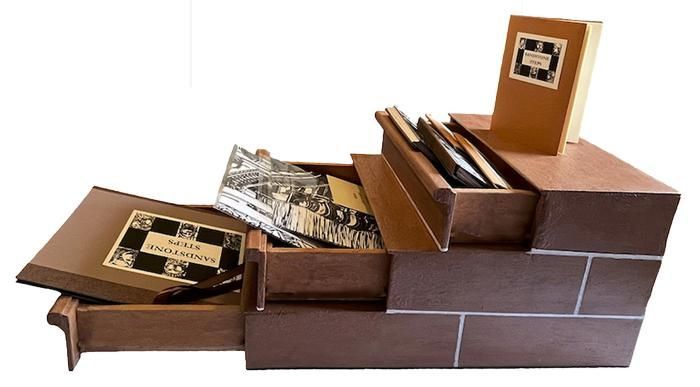
An artist's book exhibition curated by Maddy Rosenberg, built around The Sandstone Steps—a transatlantic collaboration exploring themes of architecture, migration, and the natural and built environments. About The Nature of Building: An artist's book exhibition built around the Sandstone Steps. The Sandstone Steps project was conceived as a transatlantic collaboration between Maddy Rosenberg (CENTRAL BOOKING) and Hugh Bryden (Roncadora Press), inspired by the Corsehill sandstone from Annan, Scotland, and its journey to New York. It is a tale of commerce, migration, but most of all art and the sometimes grandiose visions behind the making. Though local Scottish folklore tells a story of the sandstone traveling as ballast from the port of Annan to form the base of the Statue of Liberty, the reality is much more complex and interesting. Due to its particular qualities of hardening slowly when exposed to air, while maintaining a feel of polished wood once hardened, the Corsehill sandstone was used for fine details in the brownstones in New York City. This led to the choice of using it extensively in the construction of the Great Western Staircase (also known as the Million Dollar Staircase, referring to its eventual cost) in the New York State Capitol building in Albany. The sandstone may have traveled from the other side of the Atlantic and up the Hudson, but New York Harbor was an important stop along the way. It was a literal building block in the balance of the integration and coexistence of the human made with natural environments. Kentler International Drawing Space, based in Red Hook, the heart of maritime Brooklyn, is an ideal venue for artists who explore the natural harbor life with the dynamics that build and alter communities. The Sandstone Steps is a limited edition artist's book in a staircase wooden box, consisting of three "steps," with each drawer individually housing its own complete art event of literary, musical, and visual elements, also working in unison to become a full spectrum experience. There are numerous themes touched on by the Sandstone Steps, explored by the more than forty artists in the Nature of Building exhibition. Architecture and design are what we see, but industry, geography, and relocation worked hand in hand over the years of construction of our thriving port city and the state capitol. Unfortunately, the records burned in the library fire of the Capitol soon after the staircase was built, leaving the identity of only one Scottish carver known for certain, as he fell while working, unprotected by scaffolding, and is buried nearby. Back home in Dumfries and Galloway is the burial ground of lives known and celebrated, interpreted by Hugh Bryden into a sculptural artist's book that combines modern verses with simulations of headstones. Agnes Murray mines the local quarries of New York with Widow Jane Mine, in atmospheric watercolors depicting the remains of what once contributed to building the iconic infrastructure of the state, including the actual foundation for the Statue of Liberty. Anne Gilman's un-earthing, a scroll that stretches to the ceiling, with a drawn nickel mine at its center, settles on the ground as a home for the sculptures molded from the sand beneath. In A Capacity to Listen: Notes from Our Collective, Lynn Sures traces an archeological path of the earliest immigrants by combining a possible text with linocut images, to relate an ancient story of beginnings. Letters to the Past is a testament to Ilse Schreiber-Noll's memory of the country and countryside she left behind in Germany and observances of her adopted land, through layered images and text obscured by sand, which becomes a metaphor in itself. Heide Hatry, also transplanted from her native Germany, in Sediments of Memory begins with what once was there and alters it as a metaphor for the journey and remembrances, as the changes of a new life take hold. For Monique Allain, Stones 1 becomes the collection of the natural objects of building and the water that brought her, symbolizing her own path along countries as she attempts to find a place in the diaspora, building an identity as an amalgam of them all. Miriam Schaer's Miniature Monuments to Everyday Traumas is a series of assemblages echoing the consistent gray tonality of a Louise Nevelson, becoming a sequence draped in the melancholia of a past and present, but with the hope of building a better place to be. With Go in there and give them your business card, Marianne R. Petit examines the pain of prejudice endured in a new environment, through the seemingly playful banality of a pop-up artist's book of an American middle-class house, as her family still found a way to transform it into a home of their own. The Vowel Trowel for Ellen Wiener is not only a physical tool for building but is transformed into an instrument for text and visual language in the need to communicate, even when a stranger in a strange land. Marilyn R. Rosenberg finds her own way through her senses with On the River Road, built up through layers of collage, gouache, ink, folds and its own asemic poetry. With Poem on Fire, Desiree Alvarez welcomes immigrants through the unusual format of a graphic novel on a fabric scroll, poetically updating the message of the Statue of Liberty with one more in keeping with the times. Nearby, Maddy Rosenberg, gathering existing architectural structures and details to construct three-dimensional reconfigured spaces, The Screening Room, from the shadows of neighboring Governors Island, is where she draws her ideal place to sit and watch. With QUOD EST FUTURUM… [That Which Is To Come…] Sumi Perera quotes from John Bunyan on future uncertainty, as maps form the core of an accordion fold, fanning out to trace an uneasy personal journey from Sri Lanka to the shores of Britain. Cynthia Back, a former resident of the Brooklyn waterfront, has used her experience in her adopted country of Portugal to examine habitation, cohabitation, and abandonment in the hand printed and collaged Quem? Quando? Porquê? Onde? The streets of a left home reverberates from the Capitol to another capital city, in Don Burmeister's Bacongo Tî Kaku Baporte Bilongi, taking us on a walk through Brazzaville, Republic of Congo, where each house front reflects the distinctiveness of the inhabitants. Brandstifter modifies a simple tourist postcard brochure, turning it into a giant identity-greetings from Lake Titi, an accordion-fold artist's book with snippets of text collaged within the ordinary vacation scenes. Islam Aly challenges us in Mare Nostrum, Al Motawaset to sail the route of immigrant travelers across the sea, as his many layered interactive artist's book guides us along the treacherous routes to a new land. While the voyage across the sea in Susan Bee's Sail Away winds through fantastical creatures in full drawn/painted/collaged color, portrayed as one of magical discovery, leads us into the port of New York. Sabra Booth's graphic woodcut technique finds a perfect collaboration in the gentle tonality of Sophie Sanders' cyanotypes, as they sink into the sea of fabric in Blue: Water as Metaphor. In transatlantic conversation, Gerhild Ebel uses a blade to eliminate pieces of line and image in a dialogue that travels and translates across continents. MALA makes no bones about it and fills a suitcase of artist's books from Brazil, compiled to travel internationally in the stead of their makers, as the individual artists deal and reflect on lives of displacement, memory, and transformation through migration. Rosaire Appel's Disturbance tackles the loss of equilibrium in even charted courses, as the disruption of text and image conceptualizes the emotional upheaval of the immigrant. Margaret Craig, with Migrants of All Species, examines the idea of the invasive ones, value judgments, and the ultimate effect on the ecosystems, in a visual splendor of hand-colored etchings, bound by ceramics, paper, and cast in acrylic. Animal Helpers of the Southwest: A Guide for Young Travelers is Art Hazelwood's bilingual journey in woodcut and screenprint of imagined animal spirits, through both dangerous crossings and a celebration of indigenous cultures. In ADCSs, the creatures of C Bangs inhabit a different kind of space, one where they are strung together and hang in sequence in an attempt to defy gravity. Eunkang Koh's Monument to Migration soars past the structure of the artist's book, as her hybrid Canadian goose/human creatures blaze their own trail, adjusting yet transforming in their new environments. Listen to the Beavers! may be a charming puppet installation once touring 14th Street past, but through it Mary Ting approaches the very serious subject of the climate crisis and the lessons these creatures can teach us. Donna Maria de Creeft's Flow is the latest in her series inspired by the Buddhist Prayer Flags, which seeks to build consensus to solve the environmental dangers in its own way. April Vollmer takes the traditional woodcut printing form of Mokuhanga to a new level with Angry Egrets Book, as the snowy egret is captured fighting over sand crabs, while the true threats lurk more in loss of their habitat from opportunistic predators, pollution, and climate change. Florence Neal's homage, A Building / A Life, rebuilds through Mokuhanga her architect father's structure, destined for imminent destruction, re-envisioning the simplicity of the forms as a way of continuing her father's legacy. Susan Happersett finds the mathematics behind it all, as in Spiral Mountain Lace, mapping the connections of the geography of nature's planning to the human neural networks. Honoring the fieldwork of mycologists, Kumi Korf sets out in Big Science to emulate the process of building through collecting and storing, a very different approach to constructing than that of the architect in her. Alan Rosner builds forms through language: The Evening Clears is a horizontal landscape turned vertical as it skirts two worlds. Upright stands tall, as Sarah Stengle combines the rigidity of engraved historical architectural elements with a dance of hand-marbling across their surfaces. Max Marek focuses in on the detail of Into the Void, as the hand moving from page to page reveals the layering of the ornamental. The work of these CENTRAL BOOKING artists speaks in many voices, not as a cacophony but in true conversation. Joining them, to widen the discourse and in the collaborative spirit, is the selected book art–related work from the Kentler Flatfiles of David Ambrose, Jessie Nebraska Gifford, Shoichi Ido & Robert Kushner, Kostas Kiritsis, Meridith McNeal, Donna Ruff, Viviane Rombaldi Seppey, and Emna Zghal. From many vantage points, these artists piece together fragments of the complicated story of building a future from a past. https://centralbookingnyc.com/exhibition/central-nature-building/ Read more Toggle Prints Installation Painting Drawing Mixed media Sculpture
Schedule
Starts
-
Sat, Nov 7, 2026 at 12:00 AM
Ends
-
Sun, Dec 13, 2026 at 11:59 PM
Location
353 Van Brunt Street, (RED HOOK), New York, New York, 11231, United States